Many patients who resort for assisted reproduction technologies, like IVF, surrogacy or PGD are often baffled with the concept of cryopreservation, vitrification and slow freezing. It is natural to get confused with peculiarities of those complicated medical procedures that seem to belong to a science-fiction movie than to our reality. How is it even possible to freeze an egg or an embryo and then warm it without causing any harm? It does sound rather fictional but modern advances in medical technologies provide such a possibility with vitrification method which is the most commonly used nowadays.
The patients who consider using ART very often enquire about what eggs provide better results – fresh or frozen? To answer this question it is necessary to look into the freezing procedures in more detail.
What is vitrification and how is it different from slow freezing?
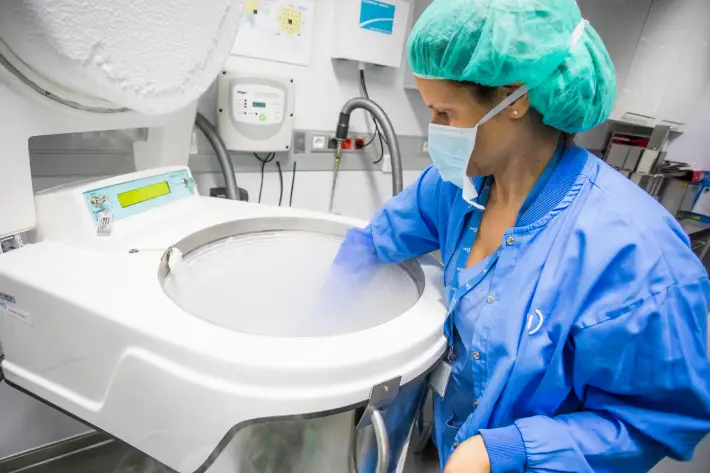
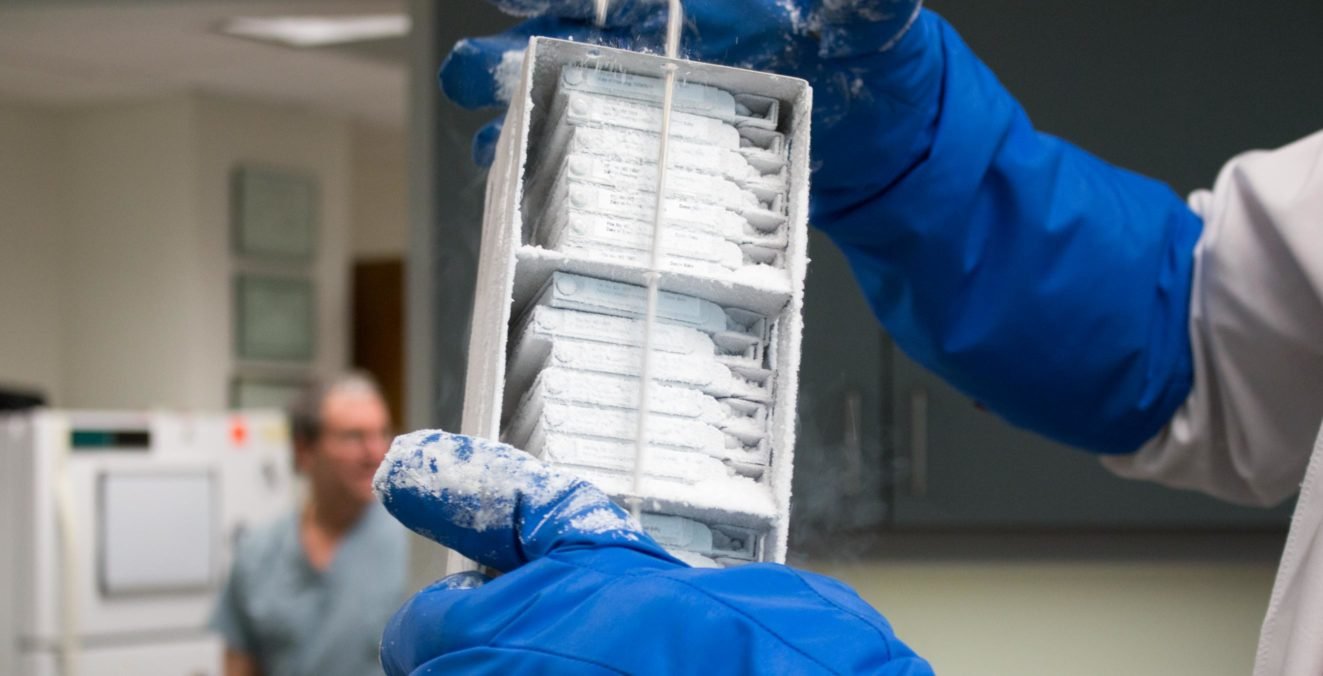
Generally, cryopreservation is a term for freezing cells, storing and thawing them in future. It comprises two most commonly applied methods of cooling the materials down – vitrification and slow freezing. Both methods were invented almost at the same time. The first successful slow freezing procedure was reported in 1983 and soon after that doctors have discovered that it may be successfully applied to assist in infertility treatment. In this method, the reproductive cells undergo a slow freezing procedure when the temperature decreases by 3-4 degrees per minute until it reaches -196 °C. Even though the procedure was recognized to be rather advantageous, the number of eggs and embryos that turned out to be damaged after thawing was too high. The percentage of eggs with good preserved morphology after warming was only about 56%.
Vitrification was invented in 1985, but scientists started using it for preserving human cells for later, and until 2013 it was labelled as an “experimental” procedure. But the latest studies have established that it is more beneficial for the preservation of human cells, and for this reason, vitrification has become one of the most commonly used freezing procedures. For instance, almost 80% of thawed eggs preserve their properties and morphology. This success rate is achieved by the speed of freezing – the cells freeze at high speed and the water in cells does not crystallise, i.e. the inner molecular structures are not damaged.
Frozen eggs vs fresh eggs: is there any difference?
It could be assumed that fresh eggs are better for fertilization but the most recent studies comparing fresh and vitrified oocytes have found out that the efficiency of IVF procedure is almost the same for them both. Since vitrification does not involve crystallization of water molecules in cells, it doesn’t damage the structure of an egg and does not decrease its fertilization features.
Egg vitrification for IVF and other related options
Egg vitrification is believed to be one of the most essential procedures in assisted reproductive technologies. Here are the most common procedures involving frozen (and fresh) eggs:
- Fresh vs frozen donor eggs. Many clinics offer oocyte donation services. After the retrieval of eggs, they are frozen until they are used for IVF in future for infertility treatment of a recipient. Naturally, recipients may often have some concerns about using frozen donor eggs. But there are absolutely no reasons for such worries because the vitrification procedure is the safest freezing procedure that doesn’t damage cell structures and for this reason, it is used even for the preservation of embryos.
- Frozen eggs vs fresh eggs IVF. Most of the fertility clinics use both types of eggs, but the success rate of frozen eggs fertilization depends on the freezing technique the one applies. Vitrification procedure enables a higher implantation and birth rate than a slow freezing procedure. The vitrified oocytes are as fertile as the fresh ones, but the price of IVF procedure with frozen eggs is considerably lower.
- Saving high-quality frozen eggs for the future. In the modern world, women have more chances for personal fulfilment, and thus more and more of them decide to postpone their pregnancy for a more appropriate time at their thirties. But with time the quality of eggs naturally declines, so in order to preserve the oocytes with greater potential for the conception of a healthy child, they opt for vitrification of eggs.
So, the difference in success rate between the use of fresh and vitrified eggs is not that drastic and what is more, vitrification of eggs presents more benefits in terms of timing and price. That is why patients should not be concerned about using vitrified eggs for ARTs.
If you still have questions about thefrozen eggs and fresh eggs, you may schedule a consultation with afertility expert, who will provide you with all the answers and help you need.