
Why Choose Czech Republic for Surrogacy
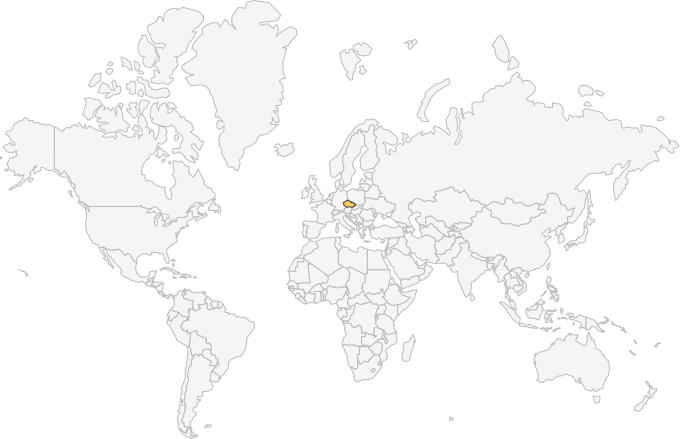
Laws and Eligibility in Czech Republic
Surrogacy in the Czech Republic is not explicitly regulated by statute. Draft bills introduced in 2024-2025 aim to regulate the surrogacy process. According to Czech law, only gestational surrogacy is allowed — the surrogate carries an embryo created by IVF using either the intended mother’s eggs or donor eggs.
Under the Czech Civil Code, the woman who gave birth is the legal mother of the child, while the Intended Father can be recognized as a legal father of the child if he has given consent for the assisted reproductive technologies. The intended parents often need to use adoption to obtain full parental rights. Our team works with Czech legislation and your home country’s requirements to ensure parental recognition through proven legal mechanisms.
Official marriage certificate is not required. This is the most straightforward legal pathway in the Czech Republic, as programs operate through international legal coordination recognizing traditional family structures. Both partners can establish parental rights through our proven legal framework.
Unlike some destinations, Czech Republic programs may require medical proof of infertility.
In the Czech Republic, only altruistic surrogacy is permitted. The surrogate mother carries the child without financial gain and may be reimbursed for reasonable medical or living expenses.
All agreements are drafted by our experienced international lawyers, notarized, and structured to protect your parental rights. Birth certificate initially lists surrogate, then legal parenthood is transferred through mechanisms coordinated with your home country law.
Steps of the Surrogacy Process in the Czech Republic
Surrogacy and IVF Statistics in the Czech Republic
Main Czech cities who provide surrogacy services:
- Prague;
- Brno.
The Czech Republic is also popular with international intended parents, who account for roughly 36% of all IVF cycles performed in the country. Many clinics are located near top hospitals and family-friendly accommodations.
According to ESHRE 2020, the Czech Republic has 48 ART clinics that performed about 33,734 IVF, ICSI, and embryo transfer cycles, highlighting the country’s advanced fertility treatment infrastructure.
Surrogacy Costs in the Czech Republic
This option is suited for intended mothers who are able to produce their own eggs. The program covers all key steps — ovarian stimulation, egg retrieval, IVF procedures, and embryo transfer to the gestational carrier — along with full pregnancy management and legal guidance within Czech Republic.

Ideal for intended parents who already have frozen embryos ready for use. We arrange secure embryo shipment to a Czech clinic, match you with a qualified surrogate mother, and coordinate every stage from transfer to birth and documentation.

This program includes professional egg donor selection from Czech donors. It provides complete medical screening, IVF with donor eggs, embryo development, surrogate matching, and ongoing pregnancy care — fully supported by our legal specialists.

A plan offering unlimited IVF attempts until a baby is born, removes financial risk and ensures professional monitoring of the surrogate, and end-to-end legal and medical coordination with local clinics and agencies.

Who Can Be a Surrogate in the Czech Republic?
At Herman Family Group, all gestational carriers are screened in partnership with a carefully selected reproductive clinic. Each candidate undergoes comprehensive medical evaluation, confirmation of previous healthy pregnancies and psychological assessment. Once agreements are finalized, treatment can typically begin within 2–3 weeks.




Frequently Asked Questions about Surrogacy in the Czech Republic
Yes, intended parents from other European countries or worldwide can pursue surrogacy in Czechia. Our team specializes in international surrogacy, providing medical and legal support through every step of the process.
According to the Czech family law, the woman who gives birth is considered the legal mother. After birth, intended parents usually obtain full parental rights through adoption. Our team guides families through every step of the transfer of the child.
The timeline typically ranges from 16–18 months, from matching with a surrogate mother to the birth of the child and completion of all legal formalities.
Intended parents may need in vitro fertilization, embryo transfer, or egg donation treatments performed in certified reproductive clinics.
Yes. Only reasonable reimbursement of medical and pregnancy-related expenses is allowed.